http://restoration.gulfofmaine.org/projects/factsheets/SebasticookRiverFactSheet.pdf 2003
In 1998, the Federal Energy Regulatory Commission ordered the decommissioning and removal of Edwards Dam in Augusta, Maine. As part of the Lower Kennebec River Comprehensive Hydropower Settlement Accord, an agreement was reached providing for the removal of Edwards Dam, for fish passage requirement at upriver dams and for funds for fisheries restoration. In order for fish passage to be mandated at two downstream hydroelectric dams, Benton Falls and Burnham, fish passage must first be secured at 4 upstream non-hydropower dams. The state of Maine has been taking the lead to seek fish passage on 4 non-hydropower dams on the Sebasticook: Sebasticook Lake outlet dam, Guilford dam, Pleasant Pond outlet dam and Plymouth Pond outlet dam. The Town of Stetson rebuilt the spillway at Pleasant Pond dam in 1999 and the Maine Department of Marine Resources removed Guilford Dam in 2002 as a result of this mandate. The state has been actively working on the remaining two dams at Sebasticook Lake and Plymouth Pond to facilitate fish passage. With removal of Edwards dam, 17 miles of riverine habitat became available for use by anadromous fish. However, with the completion of further fish passage projects an additional 28 miles of riverine habitat will be open for use by anadromous fish.
With assistance from the NOAA Community-based Restoration Program, the State of Maine along with support from other project partners is taking the lead to restore fish passage to Sebasticook Lake and Plymouth Pond through installation of fish ladders as well as some stream restoration work along the Sebasticook River.
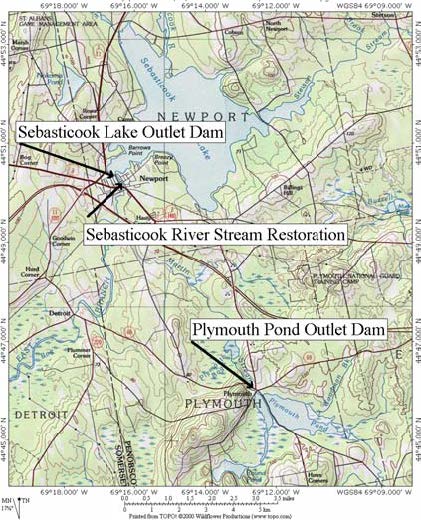
At the Sebasticook Lake Dam a pool and chute fishway was constructed in 2003 to allow fish passage into the lake. The fishway is located on the eastern side of the lake and provides excellent public viewing with a small park located directly adjacent. The Town of Newport is leading this effort and the total costs for this project were estimated to be $352,000.
 Everything Eats Alewives